Unitary Method


Understanding the Unitary Method
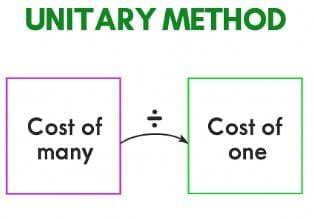
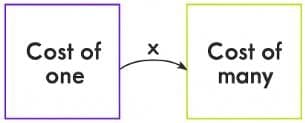
The unitary method is a practical technique for tackling problems by determining the worth of one single unit first. With the value of that one unit in hand, you can easily scale it up through multiplication to find the value for larger quantities. This approach is ideal for uncovering any unknown figures in a scenario and proves handy in daily scenarios involving expenses, durations, velocities, distances, labor, and amounts. Additionally, it allows for straightforward comparisons between quantities to determine their proportions, streamlining calculations and saving time.
What is the Unitary Method?
Definition of the Unitary Method: This is a step-by-step mathematical technique used to derive the value of one unit based on the known value of several units, or conversely, to compute the value for multiple units starting from a single unit's value.
It serves as a computational tool to determine metrics like price, pace, or other measures for any specified amount. The key requirement for applying this method is having the values for a set number of units upfront, which then enables you to extend those figures to the target quantity using the unitary approach.
Example: If we have been provided with data where it is said that 3 students can together complete a group project within 5hrs, and we need to calculate how many hours it is required to complete that project if the group has 5 students.
Here we have a value of a certain quantity i.e., 3 students need 5 hrs to complete, and we need to find the value for a desired quantity i.e., number of hours required by 5 students.
So we can use the Unitary Method here to get the desired value.
So, Number of hours taken by 1 student = 5/3 = 1.6667.
Therefore, Number of hours taken by 5 students = 1.6667×5 = 8.3335
Types of Variation in the Unitary Method
The Unitary Method involves two primary forms of variation, often applied in the context of the coefficient of variation.
Direct Variation
This refers to a proportional relationship where the given quantity and the required quantity change in the same direction. In essence, an increase in one quantity leads to an increase in the other, and a decrease in one results in a decrease in the other. We can describe it as one quantity being directly proportional to the other. For instance, as the speed of a vehicle rises, the distance it travels in a fixed time grows accordingly; conversely, slower speeds result in shorter distances. This illustrates a direct variation among speed, time, and distance.
Indirect Variation
This describes an inverse relationship between the given quantity and the required quantity, where changes occur in opposite directions. That is, when one quantity rises, the other falls, and vice versa. It can be expressed as one quantity being inversely proportional to the other. For example, higher speeds reduce the time needed to travel a set distance, while lower speeds extend that time. This demonstrates an indirect variation between speed and time.
Steps to use Unitary Method
The steps to use the unitary method are mentioned below.
- Step 1: First we find the value of unit quantity by dividing the given value by the given quantity. Thus we obtain the value of unit quantity.
- Step 2: We then multiply the required quantity with the obtained value. Therefore we get the value of the required quantity.
Example:
We have been given the cost of buying 10 balls which is Rs 95, and we need to calculate the cost of 7 balls.
So according to the above mentioned step 1 we first find the value unit quantity i.e, cost of buying one ball = 95/10 = Rs 9.5
Now we can calculate the value of required quantity mentioned in step 2 by multiplying the cost of 1 ball with the obtained value, i.e., 9.5 x 7 = Rs 68.5
Thus we get the cost of 7 balls using unitary method which is Rs 68.5
Unitary Method in Ratio and Proportion
The Unitary Method is also used to find the ratio of one quantity with respect to another quantity. The concepts of ratio-proportion and unitary method are very much inter-related. The sums of ratio and proportion exercises are based on fractions. A fraction is represented as a:b. The terms a and b can be any two integers.
Example : The Income of Harish is Rs 20000 per month, and that of Shalini is Rs 191520 per annum. If the monthly expenditure of each of them is Rs 9000 per month, find the ratio of their savings.
Here,
- Savings of Harish per month = 20000-9000 = 11000.
- Income of Shalini per month = 191520/12 = 15960
- Savings of Shalini per month = 15960-9000 = 6960
- Therefore, ratio of saving of Harish with respect to savings to Shalini = 11000/6960 = 1.58046
Applications of Unitary Method
The unitary method is a simple and useful technique for solving everyday problems. It helps us find the value of one item or many items using basic multiplication and division. Here are some common applications explained in detail
- Finding Cost of Items:
If you know the price of a single item, you can get the price of many items. Again, if you know the cost of many items, you can get the cost of an individual item.
Example: If 1 notebook is Cost 3, then 15 notebooks are Cost 3 × 15 = 45. - Time, Speed, and Distance Problems:
The unitary method helps calculate how long it takes to travel a certain distance or the speed required to cover it.
Example: If a car travels 60 km in 2 hours, the time to travel 90 km is (2 ÷ 60) × 90 = 3 hours. - Work and Labour Problems:
It can be used to find out how much work one person does in a day or how long a group will take to complete a task.
Example: If A can complete a job in 10 days, A's 1 day work = 1/10. If B can complete it in 5 days, B's 1 day work = 1/5. Together, 1 day's work = 1/10 + 1/5 = 3/10. Total days required = 10/3 ≈ 3.33 days. - Population and Quantity Problems:
The unitary method helps calculate quantities such as population growth, distribution of items, or production output.
Example: If 4 boxes contain 48 chocolates, 1 box has 48 ÷ 4 = 12 chocolates. - Money and Finance Problems:
It is useful for calculating wages, interest, and other financial matters.
Example: If a worker earns £120 in 8 days, his earnings for 1 day = 120 ÷ 8 = 15.
Unitary Method For Speed Distance Time
The unitary method for speed, distance, and time is a way to solve problems by first finding the time, distance, or speed for one unit. Once you know the value of one unit, you can easily calculate for any number of units. This method makes solving such problems simple and quick.
Example: A bike travels at a speed of 60 km/h and covers 180 km. How long will it take to cover 90 km?
Solution:
First, find the time to cover 180 km:
Speed = Distance ÷ Time
60 = 180 ÷ T
T = 3 hours
Using the unitary method:
180 km = 3 hours
1 km = 3 ÷ 180 hours
90 km = (3 ÷ 180) × 90 = 1.5 hours
Unitary Method For Time and Work
The unitary method for time and work helps find out how long it takes to complete a task by first calculating the work done in one day. Once the work done by one person or unit in a day is known, it is easy to find the time needed for any number of people or units. This method makes solving work-related problems simple.
Example: X can complete a task in 12 days, and Y can complete the same task in 8 days. How many days will it take if they work together?
Solution:
X's 1 day work = 1 ÷ 12
Y's 1 day work = 1 ÷ 8
Total 1 day work = 1/12 + 1/8 = (2 + 3)/24 = 5/24
Time to complete work together = 24 ÷ 5 = 4.8 days
So, X and Y can complete the task in 4.8 days working together.
Important Notes on the Unitary Method
The unitary method is a simple way to solve problems involving quantities and their values. Here are the key points explained clearly:
- Finding the Value of Many Quantities:
If you know the value of a single item, you can find the total value of many such items by multiplying the value of one item by the total number of items.
Example: If 1 pen costs £5, then 10 pens will cost 5 × 10 = £50. - Finding the Value of One Quantity:
If you know the total value of many items, you can find the value of a single item by dividing the total value by the number of items.
Example: If 12 pencils cost £24 in total, the cost of 1 pencil will be 24 ÷ 12 = £2.
This method helps solve a variety of problems in daily life, such as finding the price of products, calculating wages, or determining distances and time. By using simple multiplication and division, you can easily work out the value of one or many quantities.
Unitary Method Solved Examples
Problem 1: The cost of 2 notebooks is Rs. 90. Calculate the cost of 10 notebooks.
Solution:
We have the given quantity as 2 and the value of these 2 quantities is Rs. 90.
First we find the value of 1 quantity,
Next we calculate the value of 10 notebooks,
Cost of 10 notebooks=Cost of 1 notebook×Number of 10 books =45×10=Rs 450
Thus we get the cost of 10 notebooks i.e., Rs. 450
Problem 2: Which of the following options is cost effective?
(i) Bottle A costs Rs.55 for 2 Liters
(ii) Bottle B costs Rs.70 for 3 Liters
Solution:
We can use the Unitary Method to choose the cost effective option. We can find the cost of 1 liter which will help us to identify the cost effective bottle.
(i) Cost of 1 liter = 55/2 =Rs. 27.5
(ii) Cost of 1 liter = 70/3 =Rs. 23.3
As the cost of 1 liter from bottle B is less than the cost of 1 liter from bottle A.
Thus bottle B is more cost effective.
FAQs on Unitary Method
| 1. What is the Unitary Method and how is it used in solving mathematical problems? |  |
| 2. How can the Unitary Method be applied in problems related to speed, distance, and time? | |
| 3. Can the Unitary Method be used to solve time and work problems? If so, how? | |
| 4. What are some important notes to remember when using the Unitary Method? | |
| 5. What are some common examples of problems solved using the Unitary Method? | |